Open-RMF · three sites · two robots that look · ROS 2
Knowing which, and knowing about a place nobody went
The demonstration this follows says plainly what it does not claim:
that a bigger floor makes an epistemic problem harder. It could not
claim otherwise. (contaminated) was a
proposition with no argument, there was one site, and the planner
therefore could not care where anything was. Floor and epistemics sat
side by side and never met.
They meet if contamination has a location. This page runs the same
pipeline over a domain in which exactly one of three sites is
contaminated and nobody knows which. That is one line of EPDDL,
(contaminated ?s - site), and it
changes the search by four orders of magnitude, the policy from four
nodes to eight, and the execution from one robot that looks to two.
It also produces a result the single-site domain cannot produce at any
floor size. Down one leaf of the policy the team finishes knowing the
state of a site no robot approached and no laser was ever pointed
at (twenty-six metres from the nearer of the two the fleet did visit,
forty-one from the other), because exactly one site is
contaminated, two have been ruled out, and the third settles itself. The derived knowledge then travels over the private channel like
any other finding, and the conjunct saying one agent must not come
to know still holds over it.
The disclaimers of the previous page still bound this one. The nine
walking figures are scenery: absent from the navigation graph,
unperceived, unavoided. The private channel is topic addressing:
the observer was not addressed on it, which is not the same as being
unable to listen. To them this page adds a third: the two robots act
one after the other, because the executor runs a policy strictly in
order. Two agents doing physical work is not two agents working at once.
And it withdraws one thing that page reported: its floor was measured
from poses the simulator does not use, and the corrected figures are
below.
The single-site domain asks whether a site is contaminated. This one asks
which of three is, and says in the initial state that exactly one
of them is, which is common knowledge, while which one is known to
nobody. The model therefore designates one world per site.
Everything else is held fixed: three agents, S5, the same semi-private
sensing action, the same two private announcements, the same shape of
goal. The measurements below are of that one change.
one site
three sites
atoms
4
12
worlds, designated
2, 2
3, 3
ground actions
30
72
AO* depth
3
6
expansions
40
838 168
policy nodes, leaves
4, 2
8, 3
robots that move
1
2
sites scanned
1
at most 2 of 3
The expansion count is the column worth reading. One site to two costs a
factor of four; two to three costs a factor of 5 700 and adds three
actions to the plan. Four sites is not solved: under the default
fifteen-second budget the search reports
Timeout at depth 7, and under a
nine-hundred-second budget it reports
Timeout at depth 8 after 901 s and
returns nothing. Both are the budget running out rather than the space
being refuted, so no claim is made here that four sites is unsolvable.
What is measured is the price of one more site: sixty times the budget
bought one further depth iteration. A version of this that wants four
sites needs a better heuristic, not a longer wait.
Three sites is solved in about six seconds on this machine:
838 168 expansions, so better than 130 000 a second. That
number is not a boast about the search. It is the reason the bringup
broke, which is further down.
The policy
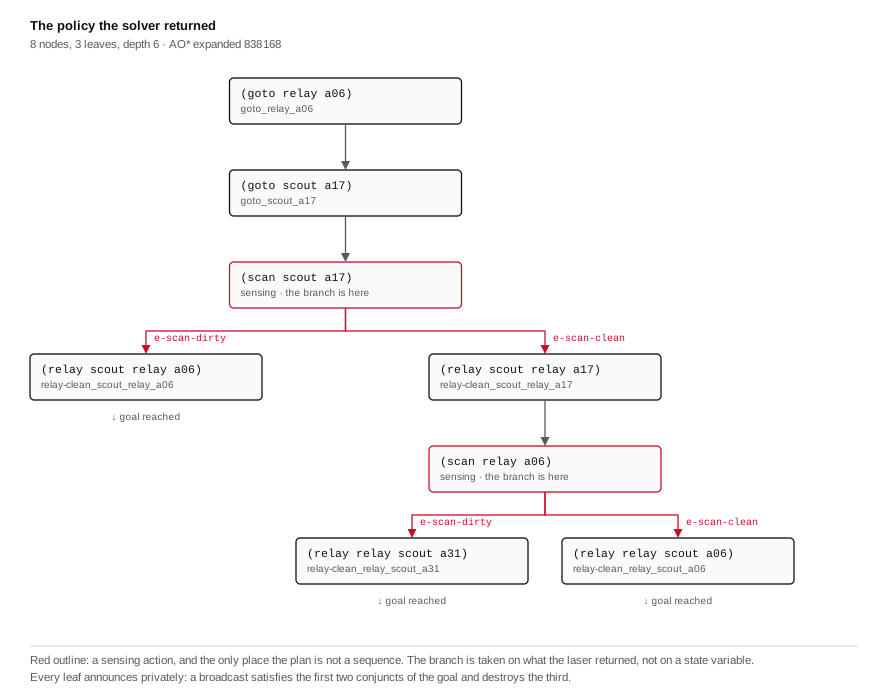
Policy structure: two sensing actions, two announcements, three leaves
Drawn from the policy the planner returned, not from a description of
it: survey_sites_mission writes what
it was handed and tools/plot_sites.py
reads that file.
Two things in it are worth stating plainly, and neither is ours: both are
the planner's.
Which robot is sent where is the planner's and not ours. The domain is
symmetric in its three sites; the assignment above is what the search
returned, and it happens to give the relay a 36.5 m errand, the
scout a 26.8 m one, and to leave
a31 alone.
Termination without observation
Exactly one site is contaminated, so ruling out two settles the third.
Down the leaf where both scans come back clean, the team finishes knowing
the state of a31, a waypoint
26.5 m from a17 and 41.4 m
from a06, which no task ever names as a
destination. In the world variant where the pallet is standing there, it
stands there unobserved for the whole run.
This is what the single-site domain cannot do at any floor size. With one
site there is nothing to eliminate, so every proposition the team ends up
knowing is one some robot measured. Here one of them is not.
Second-order content of the announcements
Including the two that convey which site is dirty.
(relay scout relay a06), on the arm where
the scout's scan came back dirty, says only that the scout knows
a06 is clean. That is enough, and the reason is second-order: after the
scan the relay considers three worlds possible, and the scout could only
know a06 to be clean in the one where its own scan found a17. The other
two are eliminated not by the content of the message but by what the
speaker's knowing it rules out.
A representation that tracked only what is true could not express that
step, and a planner that reasoned only about facts could not have found
it. It is the plainest thing on this page that requires a Kripke model.
The sites
Selection of sites by measurement
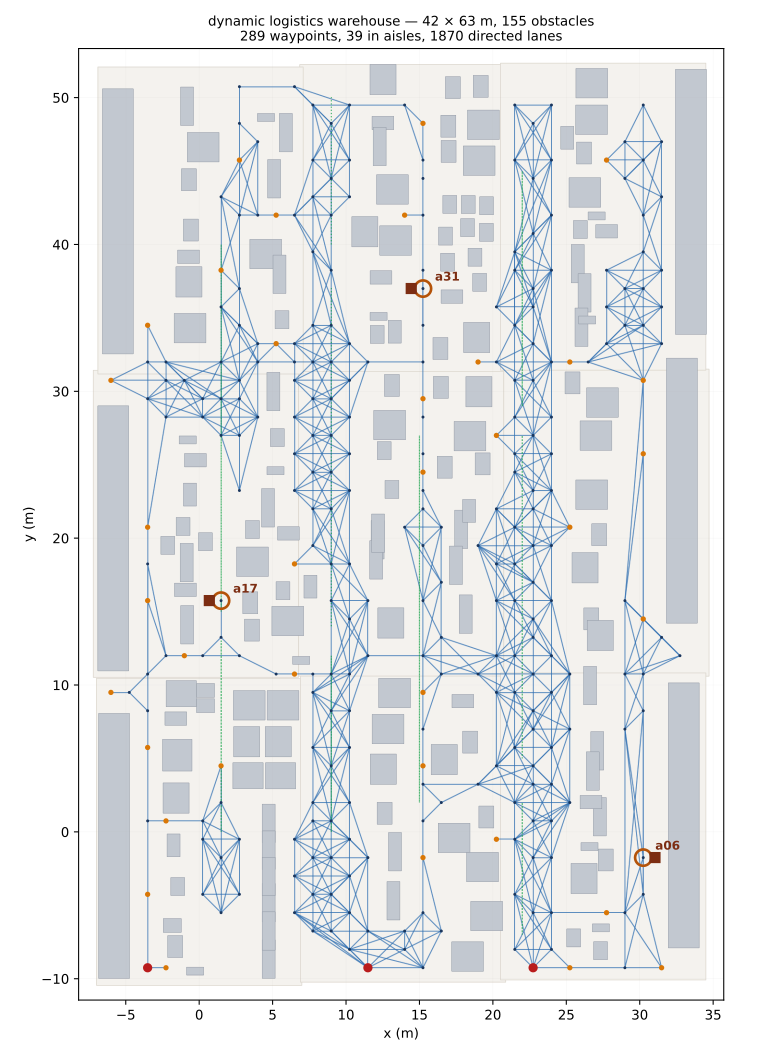
The three sites on the roadmap derived from the corrected floor: 289
waypoints, 1 870 directed lanes, 155 obstacles. Grey is obstacle,
blue the lanes, orange the aisle waypoints, red the chargers, green
dotted the circuits of the nine actors. The ringed waypoints are the sites and the
dark squares the pallet positions: one per world variant, and
only one present in any run.
A site has to satisfy three things at once, and none is a matter of
taste. A laser standing on it must read open in a world with
nothing there, or the sensing action reports contamination in every world
including the empty ones. The pallet that makes one world differ from
another must stand on floor, clear of the racks, and clear of every lane
the fleet may drive. And the two readings must fall unambiguously either
side of the threshold, or the branch is decided by where the fleet
happened to stop rather than by what is in the aisle.
tools/check_sites.py decides all three
from the world's own collision extents, the same footprint table
the navigation graph is rasterised from, so the two cannot disagree.
Thirteen of the thirty-nine aisle waypoints qualify. a17 is a dead end: one lane in, and it is the way out.
site
at
empty world reads
pallet
reads
off the nearest lane
a17
(1.49, 15.75)
1.48 m
west
0.35 m
0.35 m
a31
(15.24, 37.00)
1.24 m
west
0.35 m
0.35 m
a06
(30.24, −1.75)
1.71 m
east
0.35 m
0.35 m
Where a side is admitted at all it is admitted by the minimum:
0.35 m beside the nearest lane, which is a robot's radius and ten
centimetres. The sides that are refused are refused because they overlap
a rack or put a prop across a lane the fleet drives. That check is the one the previous iteration
shipped without and then needed, when a pallet jack placed for appearance
overlapped a charger's lane by twenty centimetres and a robot stood
pressed against it while RMF reported its task underway and nothing
anywhere reported a collision.
The analytic model can be checked against the simulator, and the check is
worth reporting in both directions. For the single-site demonstration's
site, on the floor as it was read before the correction below, it
predicted 0.89 m in an empty world and a pallet face at
0.35 m; that demonstration measured 0.88–0.89 m and
0.32–0.34 m, and a multi-site run on the same floor measured
0.89 m. The pallet face is reliable, because the pallet is a box
whose height the model and the laser agree on.
The empty-world reading is not, and the runs below show it: the model
predicts 1.71 m at a06 and the
laser returned 2.25 m, and it predicts 1.48 m at
a17 where the laser returned 0.97 and
1.08 m. Both differences have the same source. The model
is two-dimensional and the laser is a plane at 0.26 m, so anything
shorter than that is an obstacle to the model and invisible to the
scan; and the nine actors are excluded from the model deliberately and
are entirely visible to the scan. What the model is good for is refusing
a site and not predicting a reading: the sites it admits have more
than a metre of clearance, and that margin is what absorbs half a metre
of disagreement.
The runs
Execution: three world variants, three leaves
The floor is built four times. The variants differ by where one pallet
stands and by nothing else: same hall, same 155 obstacles, same nine
actors, same navigation graph, same binary, same domain, same goal, same
0.70 m threshold. One object moves.
pallet at
scan a17
scan a06
leaf taken
actions
checks
a17
dirty, 0.33 m
not reached
relay-clean_scout_relay_a06
4
11 of 11
a06
clean, 1.08 m
dirty, 0.41 m
relay-clean_relay_scout_a31
6
11 of 11
a31
clean, 0.97 m
clean, 2.25 m
relay-clean_relay_scout_a06
6
11 of 11
Three worlds, three different leaves of one policy, and the leaf is
decided by numbers read off two lasers. The third row is the one the
domain exists for: both scans return clean, nothing is ever measured at
a31, and the team concludes a31 anyway.
The third row, executed. Left: the whole 2 328 m²
roadmap with the fleet on it. Right: a camera trailing the scout at
2.6 m, driven over Gazebo transport by
src/chase_camera.cpp. The documented
way, gz camera -f, waits
for a subscriber that does not exist and blocks for ever. The transit
is sampled at 6× and the epistemic sequence played at 0.6×,
because eight minutes of driving and fifteen seconds of reasoning do
not share a speed. Captions are matched against the mission's own log
and timed by the ROS timestamp of the line that carries them, so a
caption saying the robot sensed something is on the frame where it did.
The closing card says what the footage cannot: the site the team ends
up knowing about is the one nobody drove to, so the frame in which the
mission succeeds looks exactly like the frame before it.
The fourth build is a control and is not in the table. The domain says
exactly one site is contaminated, so a world with no pallet contradicts
the problem the planner was given; running it shows what the fleet does
when the world and the model disagree, which is worth knowing and is not
a demonstration of anything working.
Perception, and what the run reports
r1 at a06 (0.27 m from it), nearest return 2.25 m -> e-scan-clean
r2 at a17 (0.31 m from it), nearest return 0.97 m -> e-scan-clean
scout says e-scan-clean on /eplansys/channel/private/relay
relay says e-scan-clean on /eplansys/channel/private/scout
mission complete
The observation is sensed and not asserted. Both scanning robots carry a
planar laser on the mast at 0.33 m, 180 beams over the full turn,
returns admitted between 0.12 and 3.5 m.
scripts/site_perception.py subscribes to
/fleet_states and to each robot's own
scan topic, and withholds any verdict until the fleet has placed that
robot within 0.40 m of a site on three consecutive reports. Only
then does it read the nearest finite return, compare it against
0.70 m, and publish.
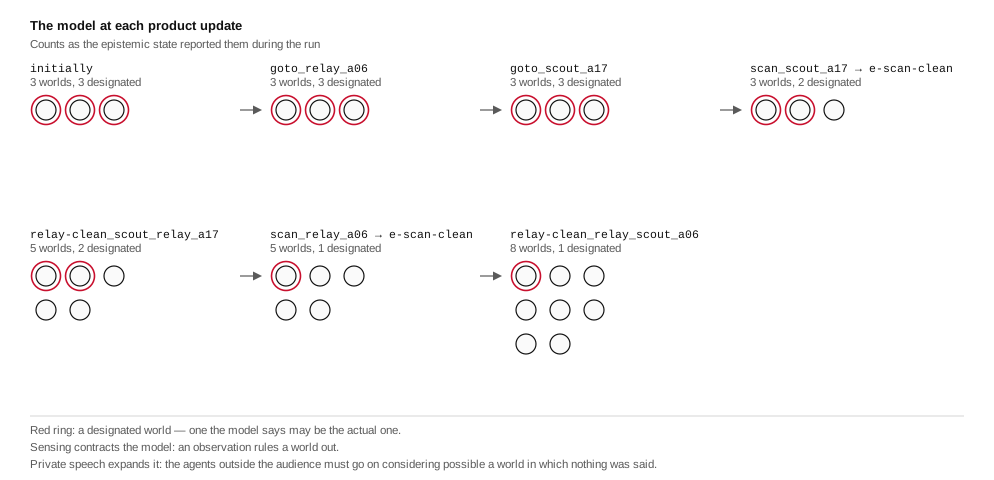
The counts are the ones the run reported, not an illustration of them:
tools/plot_sites.py reads them out of
the log above.
Sensing contracts the model and private speech expands it, for the same
reason as on the single-site floor: learning something removes
possibilities, and telling somebody something privately adds one, because
the agents outside the audience must go on considering possible a world
in which nothing was said. What is new here is the middle of the table.
A scan that comes back clean does not settle anything on its own: it
takes the designated set from three to two and leaves the team unable to
say which of the remaining pair it is in. Only the second scan settles
it, and the team has to spend a second announcement after that before
the goal holds.
Frame properties after product update
The problem declares :finitary-S5-theories
and the parser reports Frame: S5. Both
statements are about the initial model. What the relations satisfy after
six product updates is a different question, and the answer was measured
off the recorded models rather than assumed.
model
|W|
scout
relay
observer
0–3
3
S5
S5
S5
4
5
S5
S5
KD45
5
5
S5
S5
KD45
6
8
S5
S5
KD45
From the first private announcement the observer's relation is serial,
transitive and euclidean, and it is not reflexive; and the worlds where
reflexivity fails are exactly the designated ones. That is not a bug. It
is what modelling an agent as oblivious to an event that occurs means:
the excluded agent does not merely fail to learn the content, it comes to
believe no announcement took place.
At the final model the observer's relation is constant: every
world maps to the same image {w1, w5,
w7}, and the actual world w2 is not in it. Three
things follow, and all three were computed from the relations:
Every propositional belief the observer holds is true. The atoms
holding at all three worlds of its image hold at w2 as well,
and w2 and w5 agree on every atom in the model.
It is ignorant of the contamination, as the goal requires: its image
contains one world for each of the three sites.
Its second-order belief is false. At w2 both the
scout and the relay know which site it is. At no world of the
observer's image do both know: at w1 the relay knows
and the scout does not, at w7 the other way round, at
w5 neither. The observer believes the mission has not
succeeded, and it has.
This is the price of the private channel, and it is not what the goal
formula measures. The goal asks that the observer not know which site is
contaminated, which is a first-order condition on one agent. What the
execution delivers is stronger and different in kind: an agent right
about every fact, ignorant of the one thing it was required to be
ignorant of, and wrong about what its colleagues know. A specification
written only in first-order epistemic conjuncts cannot tell an agent kept
in the dark from an agent given a false picture of the others, and those
are different operational conditions.
Evaluation of the goal formula
ok   (Kw scout contaminated_a06) holds
ok   (Kw scout contaminated_a17) holds
ok   (Kw scout contaminated_a31) holds
ok   (Kw relay contaminated_a06) holds
ok   (Kw relay contaminated_a17) holds
ok   (Kw relay contaminated_a31) holds
ok   (Kw observer contaminated_a06) does not hold
ok   (Kw observer contaminated_a17) does not hold
ok   (Kw observer contaminated_a31) does not hold
ok   relay was spoken to, 1 time(s)
ok   observer was spoken to by nobody
the mission came out as specified: 9 formulas against the state the fleet left behind, and 2 transcript(s) of who was spoken to.
The first nine interrogate the epistemic state and establish where the
model finished. The last two read the agents' radio transcripts and
establish who was in fact addressed. They are claims of different kinds,
and the second is the weaker: a negative epistemic conjunct is satisfied
by everything that fails to occur, so a procedure consulting only the
model cannot tell deliberate secrecy from an absence of communication.
What broke
Eight defects, and the interface each was found at
None is an error inside any component. Each is a property of the
composition, and each was invisible while the domain had one site and one
robot that looked.
Symptom
Cause
Class
The navigation graph is a floor plan of a warehouse the
simulator does not load
The world carries a saved
<state> block, and
Gazebo applies it over the poses the models declare. Fourteen
disagree, one by 149 m
Geometric
A 14 × 21 m floor slab is placed at the
origin
Two <state> poses have
their numbers run together, so a whitespace split yields a
token that is not a number and the obvious fallback is zero
Parsing
The graph routes through a bucket and a desk
Both are nested inside a <model
name="Untitled"> group. A scan of the world's direct
children sees only the group, whose name is in no footprint
table
Geometric
The planner returns a good policy to a system that has already
shut down; the mission fails at
send_goal failed
The readiness test was “does the domain expert
answer”, and a configured node answers. A
seven-second search then starves the bringup's own activation
calls, which share the process
Race
A scan reports a genuine measurement, taken by the right sensor
at the right place, for the wrong site
One performer per action name and one latched observation
topic. The second scan is handed the first one's answer the
moment it subscribes
Composition
The executor prints
Error checking over all reqs
fifty times a second, for ever
Four files name the sites and nothing checked they agreed. Three
were renamed and the fourth was not, so the mission declared
objects the policy does not mention
Duplication
One branch of three sits for ever on
Error checking at start reqs: (and
(scanned scout a06))
The classical half required the speaker of an announcement to
have scanned the site it names. This domain's whole point is
that it need not have
Modelling
The post-run check reports three formulas
UNCHECKED and the mission
failed, on a run that came out exactly as the goal asked
The check node's defaults are the single-site formulas, and
this domain has no atom
contaminated: plank grounds
(contaminated ?s) into one atom
per site
Configuration
The floor was measured from poses the simulator does not use
This is the one that matters, because it is upstream of everything. A
Gazebo world may carry a saved
<state> block recording where every
model actually is, and Gazebo applies it at load in preference to the
poses declared on the models themselves. This world has one, recording
178 poses. Fourteen of them disagree with the declaration: by 0.19 m
for one floor slab, by 3.8 and 4.1 m for two more, by 49.8 m
for a fourth, and by 149 m for a cluttering prop that the
declaration puts inside the building and the state puts well outside it.
The rasteriser read the declarations. So the map had obstacles where the
floor is clear, clear floor where an obstacle stands, and slabs in the
wrong place, and every symptom of that is a robot behaving
correctly in a world the planner has the wrong map of, which is the
hardest kind of fault to attribute.
declared poses
the poses Gazebo loads
obstacles
153
155
waypoints
261
289
directed lanes
1 652
1 870
aisle waypoints
35
39
chargers
all three moved, one by 11 m
The figures the previous page reports are the left-hand column. They are
superseded by the right.
The charger move is why the fleet launch now reads spawn poses from the
graph rather than holding them as constants: a pose copied from an older
graph puts a robot somewhere RMF does not think it is, and the first
command is then issued from a place the robot is not. And the single-site
demonstration's own site does not survive the correction (on the corrected
floor no side of it admits the pallet), so that
demonstration now runs at a17 too.
A race condition the smaller domain concealed
The whole planning system is one process, and a plan request is served on
the same executor the bringup's lifecycle calls arrive on. Solving the
single-site problem is forty expansions and returns before anybody
notices. Solving this one holds the process for seven seconds, during
which the lifecycle manager's activate calls go unanswered and the
bringup gives up with
Failed to start plansys2!. The planner
then hands back a perfectly good eight-node policy, and the mission dies
forty log lines and several seconds later on an unrelated-looking error.
The fix is to wait for every managed node to be active rather than
merely to answer.
The search time is a property of the domain. The bringup is a property of
the framework. They interact because they share a process, and nothing in
either says so.
Attribution of observations to places
The first fix for the shared observation topic was to timestamp readings
and ignore any that predated the action. It is wrong, and running it
shows why: a robot commonly arrives at its site during the
goto that precedes the scan, so the
correct reading is already seconds old when the scan begins. A rule that
accepted only fresh readings would discard the right answer and fall
through to the task map's stand-in, which, because the launch
writes that stand-in from the same argument that places the pallet, would
have been correct, and the defect would have shipped invisible.
Readings are therefore published as
<site> <outcome> and the
bridge looks up the site its action names. Two scans of two places cannot
answer for each other however they are ordered in time.
A classical precondition contradicting the domain
The classical half of this mission is deliberately blind (it cannot tell a
broadcast from an encrypted relay), but it still
gates the actions the executor drives, and one of its gates was an
assumption this domain exists to refute. relay
required (scanned ?from ?s): the speaker
must have scanned the site it reports on. With one of three sites
contaminated, ruling two out settles the third, so the announcement that
carries the finding names a site the speaker has never been to.
What makes it worth recording is that only one branch shows it. Where the
first scan comes back clean the relay is about the site just scanned, and
the condition holds; where it comes back dirty the relay is about a
different site, and the executor sits on the failed condition for ever.
Two of the three worlds ran green with the wrong condition in
place.
A correct refusal by the post-run check
Given the wrong formulas, the post-run check reported them
UNCHECKED and failed the run rather than
reporting that nothing holds. That distinction is the one the previous
page argued for (a transcript that fails to arrive is not an agent that
heard nothing), and here it is the difference between
“your formulas are wrong” and “your mission
failed”. A check that answered false to a question it could
not parse would have made a correct run look like a broken one, and a
broken one look correct.
One observation without explanation
On the floor as it was read before the correction, the scout stopped 2.5
metres short of its site, in open floor with 1.05 m of clearance,
and never moved again. It did so twice, at the same coordinates to three
decimals. Its own laser saw something 0.23 m behind it, fixed in the
world (moving the robot 0.86 m moved the reading by 0.85 m at
the same bearing), and nothing in the world file,
at any nesting depth, in the declared poses or the recorded ones, and no
actor on any of its trajectory legs, is within 1.9 m of that point.
The fleet manager reported the robot 10.5 seconds from its destination
for four minutes.
It has not recurred on the corrected floor and it is not understood. It
is recorded because a stall that presents as a task permanently underway,
with no component reporting an error, is the same signature as the pallet
jack, and because an unexplained observation is worth more written down
than left out.
Scope
What the runs establish
Stated in the existential register: there exists a run in which each held.
A team came to know something about a place none of its members
visited. Both scans returned clean, the third site was settled by
elimination, and the finding travelled over the private channel like any
other. The negative conjunct held over it, checked against the model and
against the transcripts.
Two robots each contributed a measurement, at sites metres apart on a
roadmap derived from the world. The relay's site and the scout's are
26.8 and 36.5 m from their chargers, and 33.7 m apart. Which sites to inspect, and in what
order, is a decision the planner takes, and the sites are transits apart.
That is the coupling between floor and epistemics the previous page
correctly said it did not have.
One policy took three different leaves in three worlds differing by
one object. A conditional policy that reaches its goal down every
branch is what planning under partial observability is for, and it is not
demonstrated by a run that only ever takes one branch.
What the runs do not establish
Concurrency. The executor runs a policy strictly in order, so the
relay's transit finishes before the scout's begins. Two agents doing
physical work is not two agents working at once, and nothing here forces
two robots into one corridor at the same moment. The instrumentation is
in place and the experiment is not.
Scaling. Three sites is one point, and four is not solved inside
an hour of budget. What is measured is the cost of the third site, not a
curve.
Object recognition. The perception node thresholds the nearest
finite return of a planar scan against a distance chosen for these sites.
It establishes that something is close to the robot at a waypoint where,
in the clean world, nothing is. It does not identify what.
Navigation among moving obstacles. The nine actors walk fixed
circuits and are absent from the navigation graph. The fleet neither
perceives nor avoids them.
Confidentiality. The private channel is realised by addressing:
any node may subscribe to any topic. The claim available is that the team
used a channel on which the excluded agent was not addressed, not that it
could not have listened.
That the floor is now right. What is established is that it was
wrong, and in what direction. The correction reads the poses Gazebo
applies rather than the ones the models declare, and the numbers above
are what follows from that; whether anything else in this world is
described in a way its own loader disagrees with has not been
established, and one stall on the old floor is still unexplained.