Epistemic SLAM · three agents · 30 × 50 m hall · ROS 2
A route through a bay no map contains
A racking block crosses the hall, and the only ways from the storage
floor to the dispatch floor are three pass-through bays in it,
t1, t2
and t3. Exactly one is open; the other
two hold staged loads. That much is common knowledge, and which bay is
open is not. Two scouts carry twelve-metre mapping lasers, and a carrier
with a 3.5 m safety scanner has to take a load through a bay it
knows to be open.
What an agent knows about a bay comes from a map. A survey is read off
the scout's own SLAM map and nothing else; an exchange is one robot's
knowledge map fused into another's, applied to the model as an
announcement; and the carrier's route is a least fixed point over a safe
set that contains a bay exactly when the carrier knows it is open. In the
recorded run both scouts find loads, the two maps together rule out two
bays, and the carrier drives 43.1 m through
t2: a bay no robot surveyed, of which the
exchanges carried not one cell.
The building is common knowledge and only the bays are not: every
robot is given the floor plan, with the three bay interiors left unknown.
Localisation is the simulator's odometry, so the SLAM maps are
records of observation and are not a test of SLAM. The radio is always
up, and the robots act one after the other because the executor runs
the policy in order. The epistemic state space is small by design: three
worlds and a policy of depth five. The size is in the floor.
Package pass_through_demo; map fusion
from epistemic_slam; formula evaluation
from mu_path_planner; policy from
eplansys. Full account
in The Pass-Through Problem (PDF): the
domain and a variant the planner exploits, the maps as knowledge, the
route as the precondition, the three worlds, and every defect found on
the way.
The run
Two surveys, two exchanges, one crossing
Left: Gazebo, the world as it is, loads included; the camera holds a
shot down each scout's bay and then follows the carrier. Right: RViz,
what each agent has observed (its knowledge map, tinted in its colour),
one tile per agent on each bay in the colour of its answer, the map
exchanges as a line from sender to receiver, and the carrier's winning
region. Under both: the policy with the node being executed marked, the
step in formal notation, and the table of what each agent knows. Every
caption is a line the run wrote, placed at the instant it wrote it;
transits are sampled at up to 4× and the epistemic events slowed
to 0.5×, and the corner says which.
action
what the run reported
model after
plan
9 nodes, 3 leaves, found in 0.2 s; the carrier is not in W(dock), which stops at the racking
3 worlds, 3 designated
survey(east, t3)
east's own map over t3: 168 of 578 cells observed, 37 occupied; e-shut
3 worlds, 2 designated
share-shut(east, carrier, t3)
16 749 cells newly known to the carrier, 163 of them in t3
3 worlds, 2 designated
survey(west, t1)
west's own map over t1: 144 of 578 observed, 17 occupied; e-shut
3 worlds, 1 designated
share-shut(west, carrier, t1)
16 707 cells newly known, 144 in t1, 0 in t2
3 worlds, 1 designated
cross(carrier, t2)
t2 lifted into the safe set by knowledge; route 43.1 m; at the dock after 90 s
1 world
What the run shows
Three findings, each drawn from the robots' own grids
Agents west,
east and
carrier. The initial model has one world
per bay, all three designated, with every relation total:
\[ s \models C_{\mathit{all}}\,\big(\mathit{open}(t_1) \oplus \mathit{open}(t_2) \oplus \mathit{open}(t_3)\big),
\qquad s \models \neg\,\mathit{Kw}_i\,\mathit{open}(t_k)\ \text{ for every } i, k. \]
Each scout is stationed at the bay on its side, which is static and
common knowledge. t2 opens onto the
carrier's own lane and is covered by no one, so the only way anyone comes
to know it is open is by ruling the other two out.
action
type
events
observers
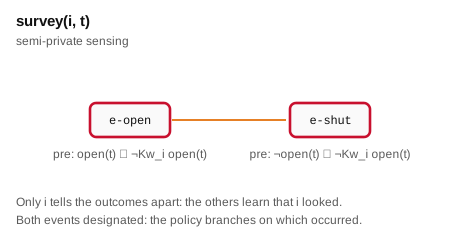
survey(i, t)
semi-private sensing
e-open: open(t) · e-shut: ¬open(t)
i fully, the rest partially
share-open(i, j, t)
semi-private announcement
Ki open(t)
i, j fully, the rest partially
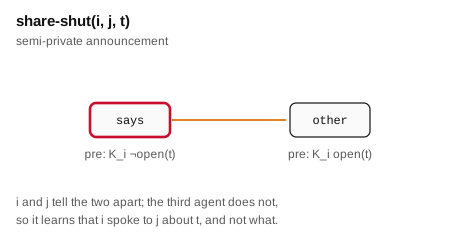
share-shut(i, j, t)
semi-private announcement
Ki ¬open(t)
i, j fully, the rest partially
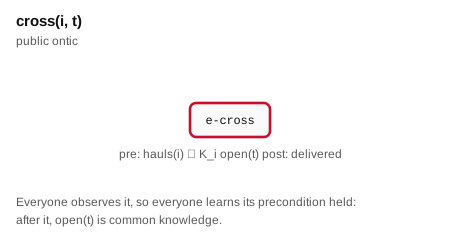
cross(i, t)
public ontic
pre hauls(i) ∧ Ki open(t); eff delivered
everyone
The goal is delivered; its epistemic
content is the precondition of cross.
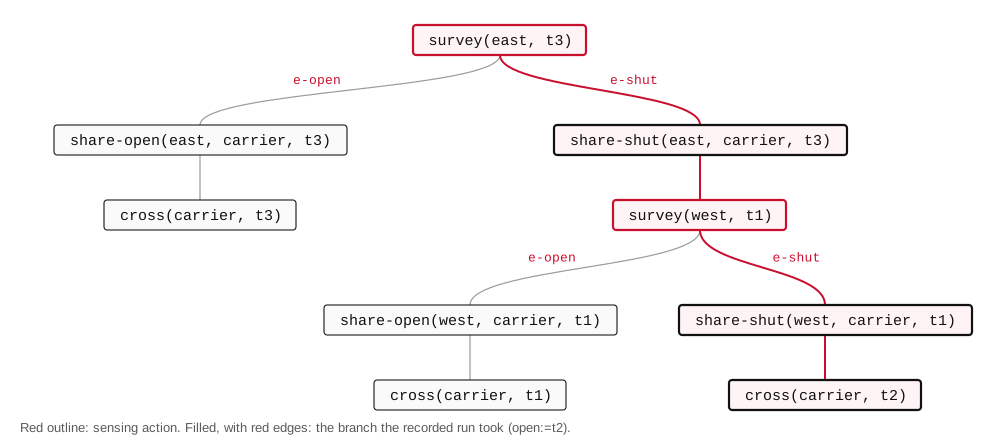
plank grounds the problem into 16 atoms and 72 ground actions, and
Aletheia returns a policy of depth five with three leaves after 445
AO* expansions.
The policy the planner returned, with the branch the recorded run took.
Which scout looks first is the planner's choice, and so is the
structure of the third leaf: two exchanges to the carrier, and no
exchange between the scouts.
The two scouts together know t2 is open
and neither of them does. The two exchanges make it the carrier's:
\(s \models K_{\mathit{carrier}}\,\mathit{open}(t_2)\), by elimination.
The crossing is public, so every agent then sees the carrier go through,
and the model collapses to one world.
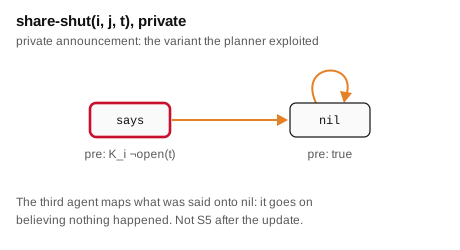
The exchanges were first written as private announcements, and the
planner then found a policy that should not exist.
The model, action by action steps through it.
The epistemic actions
Four event models, and what each does to a model
Every action of the domain is an event model: a set of events, each with
a precondition and possibly a postcondition, and for every agent a
relation saying which events that agent cannot tell apart. Executing it
in a model \(M\) is the product update \(M \otimes E\): a world of the
result is a pair of a world and an event whose precondition holds there,
and two pairs are indistinguishable to an agent when it could not tell
the worlds apart and cannot tell the events apart. Which agent
observes what is therefore entirely a property of the relation on
events, and the four diagrams below are the whole of the domain's
dynamics.
action
|E|
designated
bound on |M ⊗ E|
what the third agent keeps
survey(i, t)
2
both
2|W|
that i looked, not what it saw
share-shut(i, j, t)
2
one
2|W|
that i spoke to j about t, not what
cross(i, t)
1
one
|W|
everything: the event is public
private variant
2
one
2|W|
the belief that nothing happened
Two properties of this set of actions carry the rest of the page. The
sensing action designates both of its events, so the executor cannot
apply it without being told which occurred; that is the point at which
the policy branches, and the point at which a map has to supply the
answer. And every non-public action lets the agents outside the audience
relate its events to one another, which is what keeps each relation an
equivalence. The one variant in which an outsider relates what happened
to nil instead is the one the planner
exploited, below.
The model, action by action
Three worlds, and who can tell them apart
The figure steps through the model after every action of the branch the
chosen world selects. A world is labelled by the bay open in it; a red
ring marks a designated world, the planner's account of which worlds may
be the actual one; a line in an agent's colour joins two worlds that agent
cannot tell apart. The table reads the model as each agent sees it from
the designated worlds, and adds the one reading no single agent has:
distributed knowledge of the two scouts, which quantifies over the
intersection of their relations.
The Kripke model after each actionOPEN BAY
WHAT EACH AGENT KNOWS, AT THE DESIGNATED WORLDS
On the t2 branch, three steps carry the
argument. After east's survey the scouts' relations differ: east has
separated the world where t3 is open from
the other two, and west and the carrier have not, because sensing is
semi-private. After west's survey the same holds with the roles
exchanged, and the intersection of the two scouts' relations at the
designated world contains exactly one world:
Neither exchange then mentions t2. Each
removes one world from the carrier's relation, the one its speaker has
ruled out, and after both the carrier's relation at the designated world
is \(\{w_2\}\). That is \(K_{\mathit{carrier}}\,\mathit{open}(t_2)\), and it
is the pair's distributed knowledge made individual. The size of the
model never changes along the way: three worlds throughout, with only the
designated set and the relations narrowing, until the public crossing
collapses it to one.
The private variant, step by step
The same stepper, over the policy the planner returned when the
exchanges were private announcements. Follow the carrier's row. After the
private exchange between the scouts the model has five worlds, and the
carrier's relation leads only to copies in which nothing was said. After
west then tells the carrier that west knows t3
is shut, the carrier's relation at the designated worlds is empty: no
world it considered possible is one in which west could have said that.
A box over an empty relation holds of every formula, so the carrier
"knows" t1 is open, and the policy sends
it through t1, which in that world is
shut.
The private variant: the carrier's relation empties
WHAT EACH AGENT KNOWS, AT THE DESIGNATED WORLDS
The models are computed by the product update of
scenarios/warehouse/tools/show_plan.py
from the task plank ground, along each branch of the returned policy.
Their world and designated counts agree with the counts the epistemic
state logged during the recorded run.
Epistemic SLAM
What an agent observed, and what it knows
Each robot runs its own slam_toolbox,
remapped off /map so that three mappers
do not write one map; if they did, every observation would be public and
the semi-private sensing of the domain would be a fiction. A knowledge
node per robot keeps two grids on the floor plan's geometry.
grid
holds
read by
own map
the robot's SLAM map, resampled
survey: a sensing action is the agent looking
knowledge map
the own map fused with every map the robot was sent
navigation, and the exchange check
A bay is read under one quantifier: blocked when any cell of its
corridor is occupied, clear when every cell has been observed
free, and undecided otherwise. The corridor is the bay less the
navigation's 0.35 m inflation from each wall, since a cell no route
can use says nothing about whether the bay can be crossed. A load decides
its bay from the mouth; an open bay does not, and a scout that stays
undecided moves in along the axis over floor its own map already shows
free, then backs out and parks off the carrier's approach.
An exchange is epistemic_slam::fuse of
the sender's knowledge map into the receiver's. The reply counts the cells
the receiver newly holds, over the grid and inside each bay, and the
performer then checks the receiver's map against the announcement: the
load after share-shut, the corridor free
after share-open, or, when the speaker
knew by elimination, nothing at all. In the recorded run the exchanges
carried 163 cells of t3, 144 of
t1, and none of
t2.
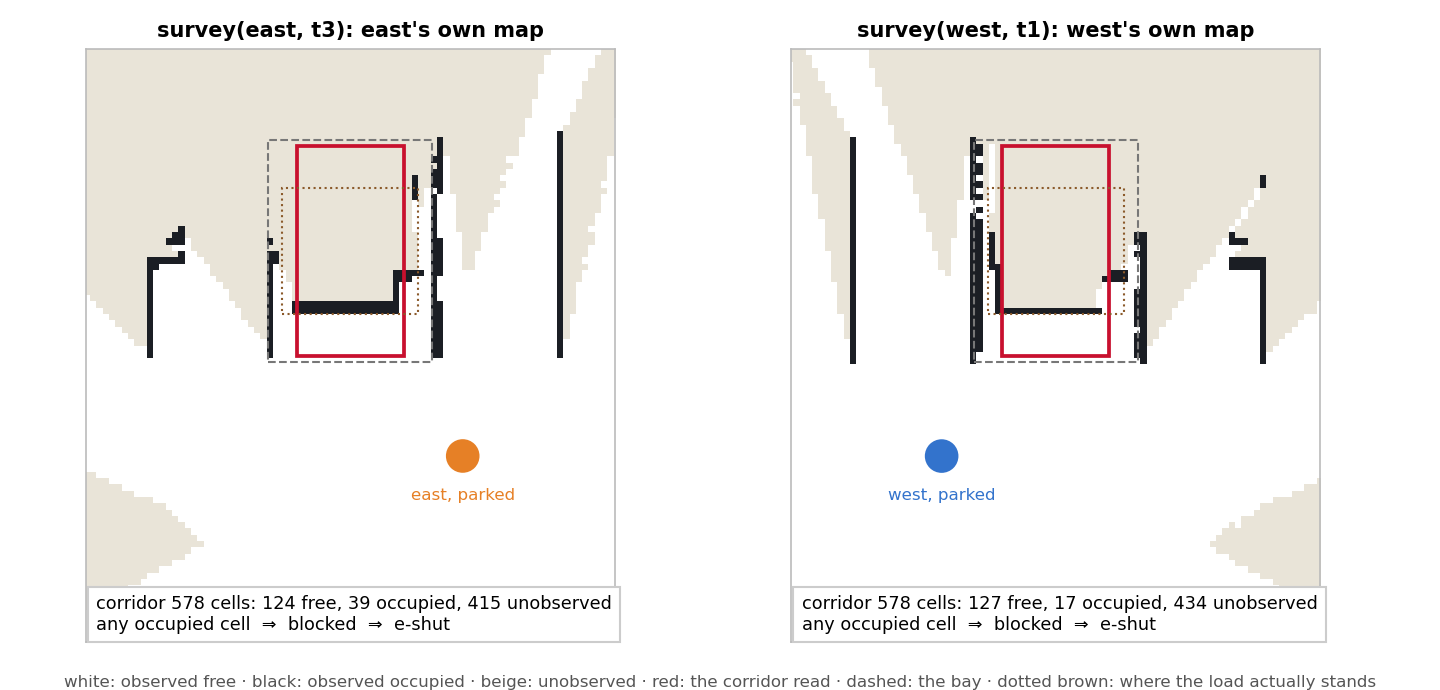
A survey, read off the scout's own map
Each scout's own map at the moment its survey was reported, around the
bay it read. The red box is the corridor the reading quantifies over.
From the standoff most of it is shadowed by the load, and it does not
matter: one occupied cell decides blocked, and the load's south
face supplies dozens. Grids from a second run of the same world,
recorded at every change of the model.
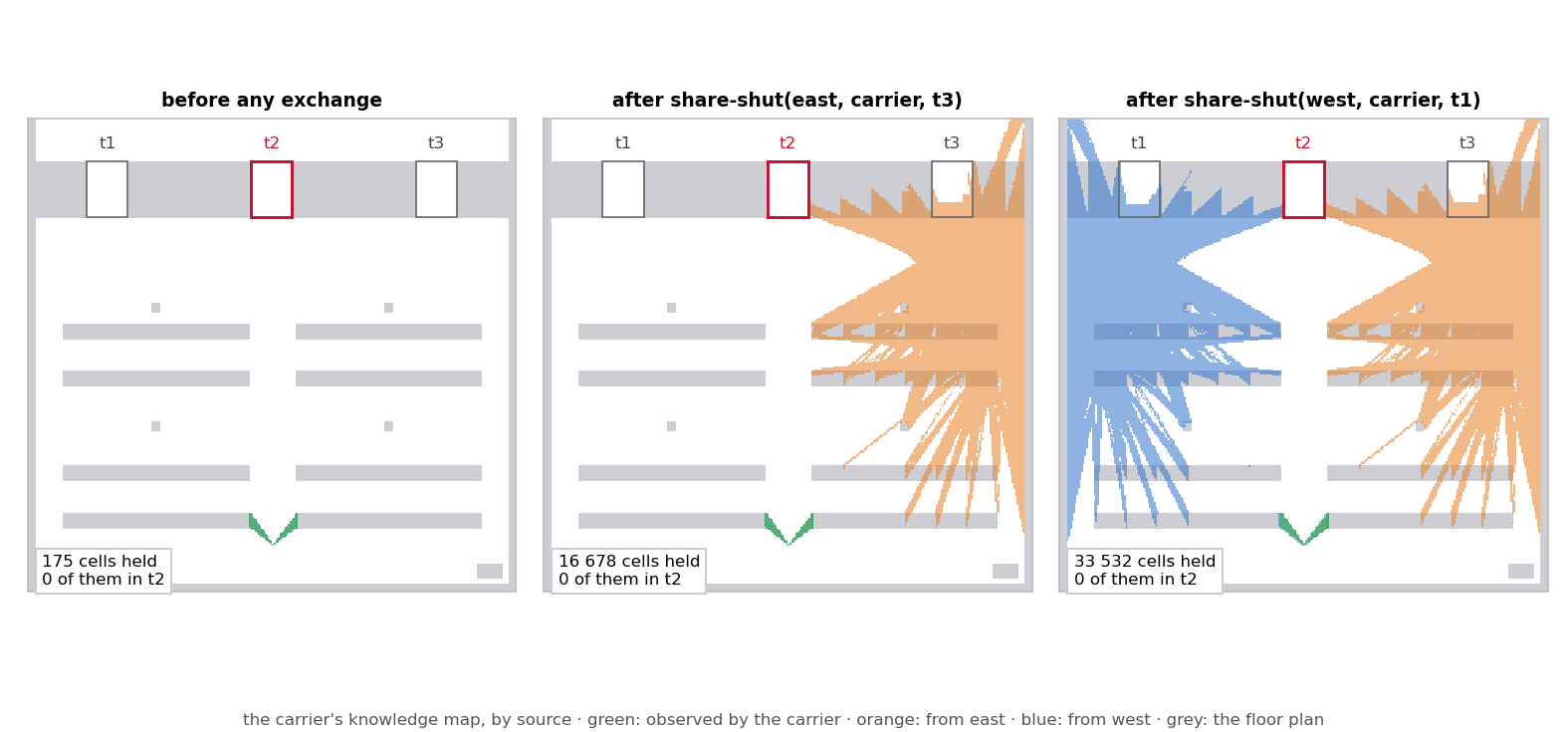
What the carrier holds, and where it came from
The carrier's knowledge map after each exchange, coloured by which robot
observed each cell. Its own 3.5 m scanner has seen 175 cells from
its start. Each fusion adds some sixteen thousand, including the loaded
bay the speaker read. The corridor of t2
is empty in all three: the carrier's knowledge that the bay is open is
in the model and in no cell.
The route
The knowledge precondition as a fixed point
cross drives the carrier along the
winning region of
evaluated at every cell and world of the model the epistemic state
publishes, by mu_path_planner's own
formula evaluator, with each bay a zone. free
reads the floor plan outside the bays and the carrier's knowledge map
inside them. A bay the carrier has observed free is safe by the first
disjunct; a bay it knows is open without having seen it is safe by the
second, and RViz draws those cells in cyan; a bay it does not know about
is in neither.
The precondition therefore holds twice and by independent roads. The
executor checks \(K_{\mathit{carrier}}\,\mathit{open}(t)\) against the
model before dispatching cross, and the
route exists only because the safe set contains the bays the carrier
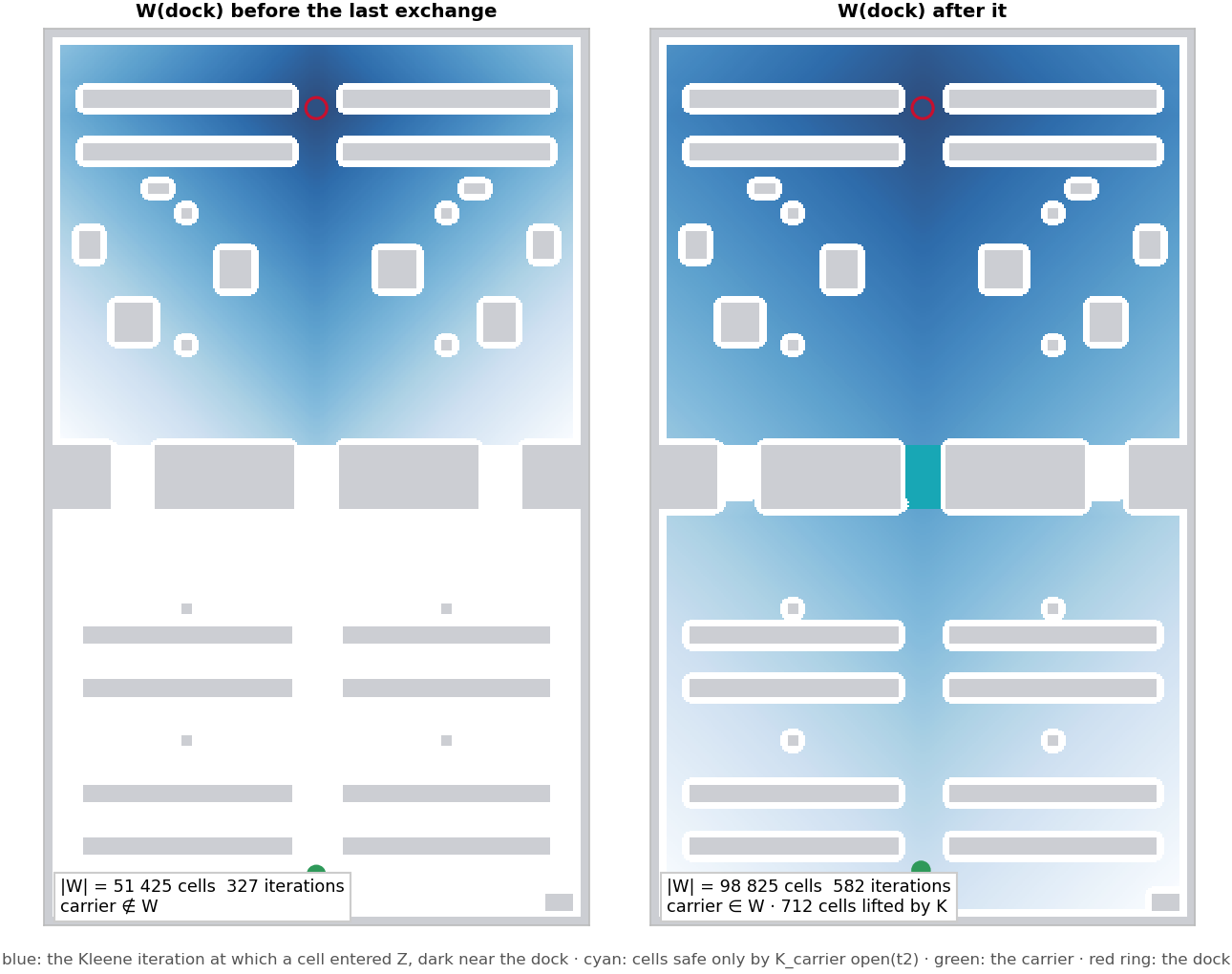
knows to be open. Before the last exchange \(W\) is 51 428 cells
after 327 iterations and stops at the racking; after it, 98 818
cells after 582 iterations, reaching the carrier through
t2.
mu_reach computes the fixed point by
Kleene iteration, recomputing the backward image of all of \(Z_k\) at every
step, which on a 310 × 510 grid is tens of seconds. The package
evaluates the same fixed point semi-naively, one visit per cell, and a
unit test checks region and iteration count against
mu_reach on sixty random floors.
The winning region, coloured by the iteration of the fixed point at which
each cell entered it. Before the last exchange the iteration stops at the
racking after 327 steps: nothing south of the block is reachable over
what the carrier knows. After it the same computation runs 582 steps and
reaches the carrier, through the one bay the formula lifts, drawn in cyan.
The iteration counts computed here from the recorded regions equal those
the carrier logged.
The carrier's own map
A metre of drift, and a corridor cut in two
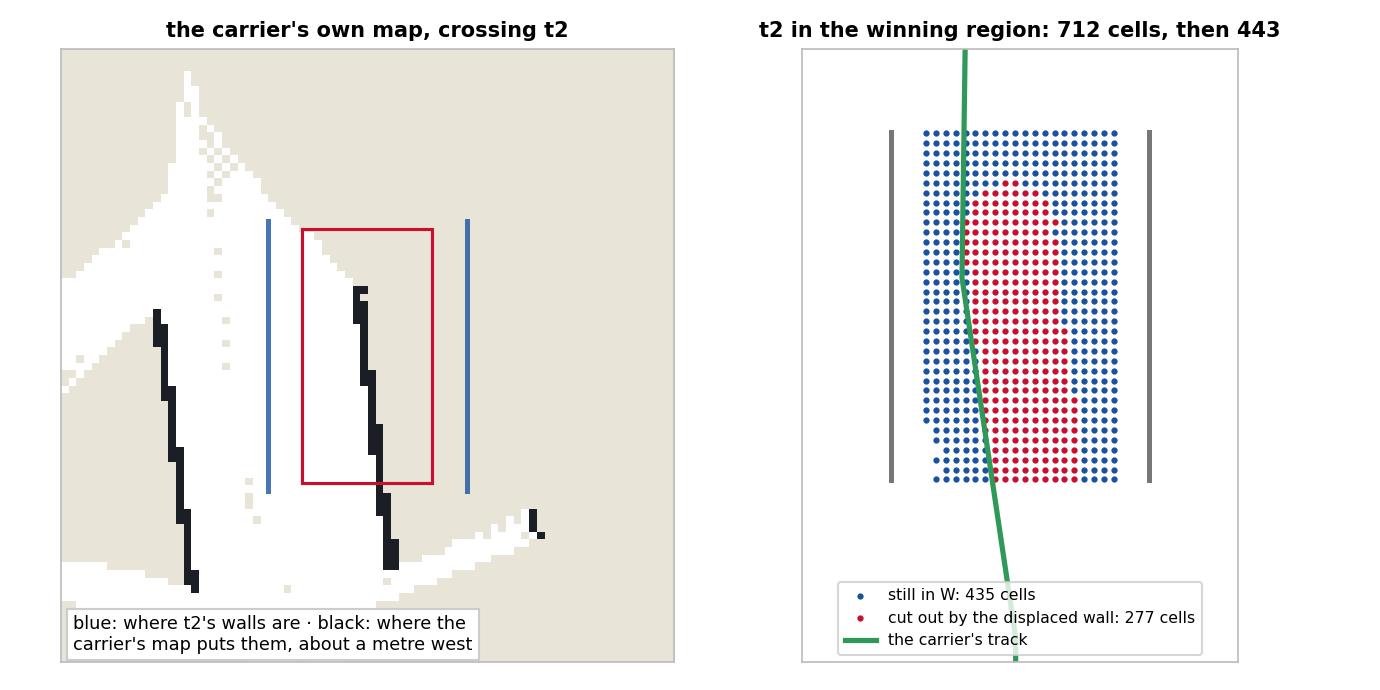
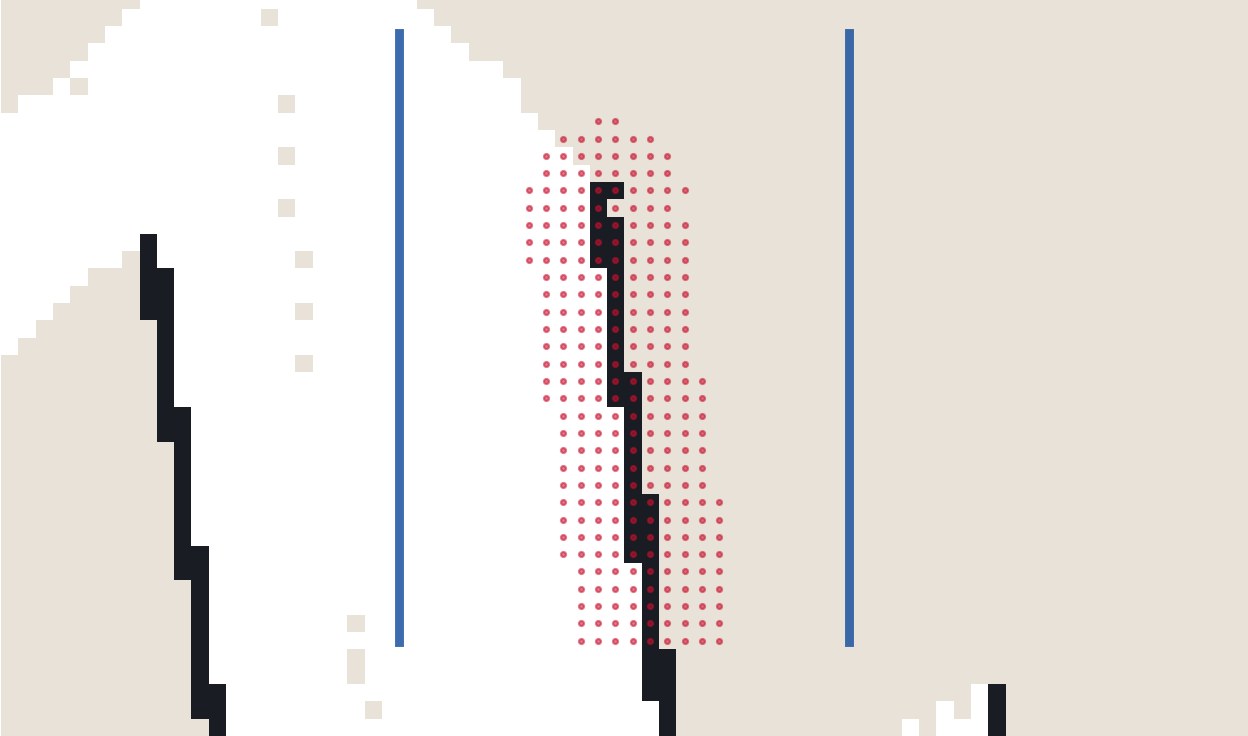
The carrier also maps as it drives, and its own map enters its knowledge
map like any other. Along the lane it is correct at the south end and
then slides west: the rack ends at \(x = \pm 1.5\) m are drawn in
place at \(y = -18\), 0.3 m west at \(y = -12\), 0.45 m at
\(y = -9\), and by the bay about a metre. A 3.5 m scanner in a
three-metre lane between repeating racks gives slam_toolbox's scan matcher
little to hold across the lane, and its correction accumulates there.
Inside t2 the displaced east wall runs
down the middle of the bay. With the navigation's inflation around it,
it removes a strip from the safe set: of the 712 cells of the bay in the
winning region before the carrier sees it, 277 are cut out once its own
scans arrive, and 435 remain, all west of the phantom wall. The carrier
drove through that western strip, at \(x \approx -0.5\) m, and
reached the dock.
The epistemic reading of this is exact, and it is the reason to draw it.
The carrier knew t2 was open by
elimination, from two maps that were right. When its own observation of
the bay arrived, it was wrong, and the knowledge map merged it without
question: \(\mathit{free}\) is read from that map inside the bays, so a
misregistered wall is an obstacle to the fixed point exactly as a load is.
The route survived because the bay is wider than the robot, not because
anything reconciled what the carrier was told with what it saw.
Three worlds
One policy, three leaves, each run to the goal
The worlds differ by which two bays hold a load and by nothing else.
Each ran headless to the goal.
open
the scouts read
carrier's route
safe by
to the dock
t3
east: t3 clear, 578 of 578 cells
60.6 m through t3
free (observed)
112 s
t1
east: t3 blocked; west: t1 clear, 578 of 578
60.7 m through t1
free (observed)
115 s
t2
east: t3 blocked; west: t1 blocked
43.1 m through t2
Kcarrier open(t2)
83 s
From the standoff the scouts saw 471 and 453 of an open bay's 578
corridor cells, and moved in to see the rest. In the first two worlds the
bay the carrier crosses is in its knowledge map, observed free, and the
formula lifts nothing. The third is the only one in which a robot drives
through a bay that no map contains.
The floor
A floor generated from one definition, and checked against its meshes
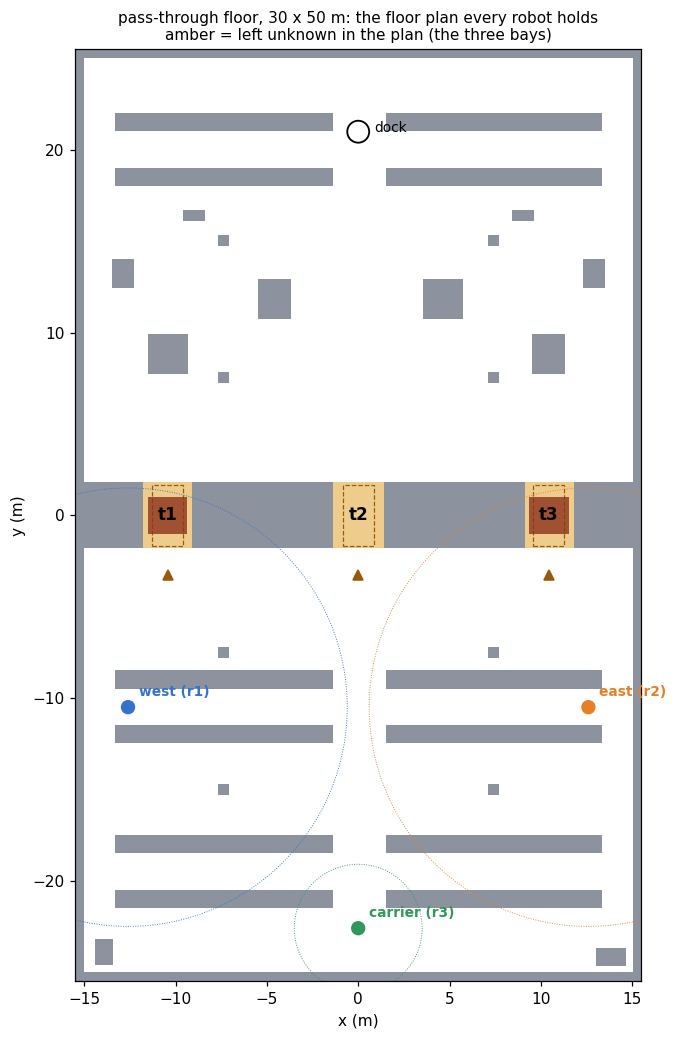
The floor plan every robot holds. Amber is what it leaves unknown: the
three bays. The loads shown are the open:=t2
world's, and are in no robot's plan.
The hall is the 30 × 50 m Fuel warehouse; the racking and
loads are AWS RoboMaker models. The world, the plan, the regions, the
poses and the camera shots are written from one layout file, and the plan
is refused unless the carrier cannot reach the dock while no bay is
known, can through each bay once that bay is, a load closes its bay, and
each scout reaches its bay's mouth and its parking place. Every placed
model's collision mesh is also sliced at laser height and required to lie
inside the box the plan draws for it.
That last check exists because of what it would have caught. The AWS
shelf footprint was first taken from a table that gives it as
0.88 × 2.613 × 3.918 m; its collision mesh, read with its
node transform and unit, is 3.918 × 0.88 × 2.64. Every unit
stood a quarter turn from the plan, the block was a row of columns with
1.7 m gaps, and it was found when the carrier stopped against the
south end of a column the plan said was not there. The table is also used
by the larger warehouse demonstrations and has not been corrected there.
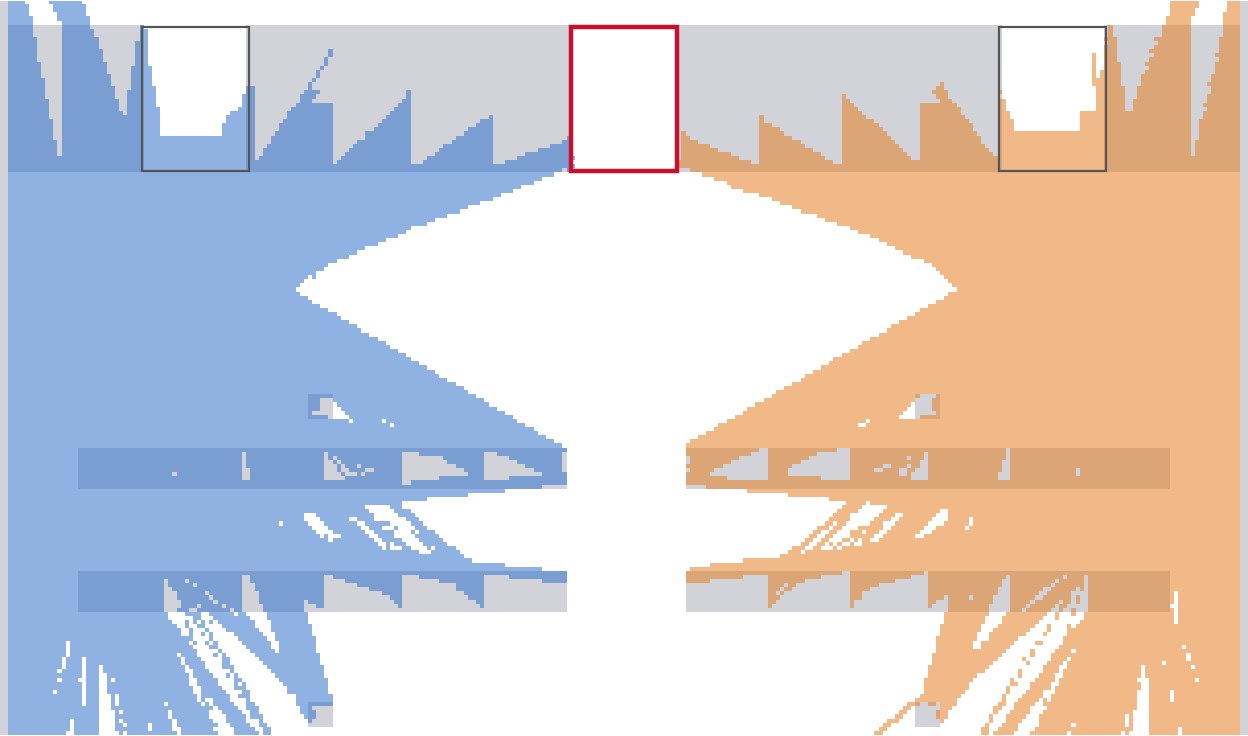 The model
Known to the pair, and to neither
After two surveys the scouts know t2 is open only jointly. Two exchanges that never mention t2 make it the carrier's.
Step through the Kripke model →
The model
Known to the pair, and to neither
After two surveys the scouts know t2 is open only jointly. Two exchanges that never mention t2 make it the carrier's.
Step through the Kripke model →
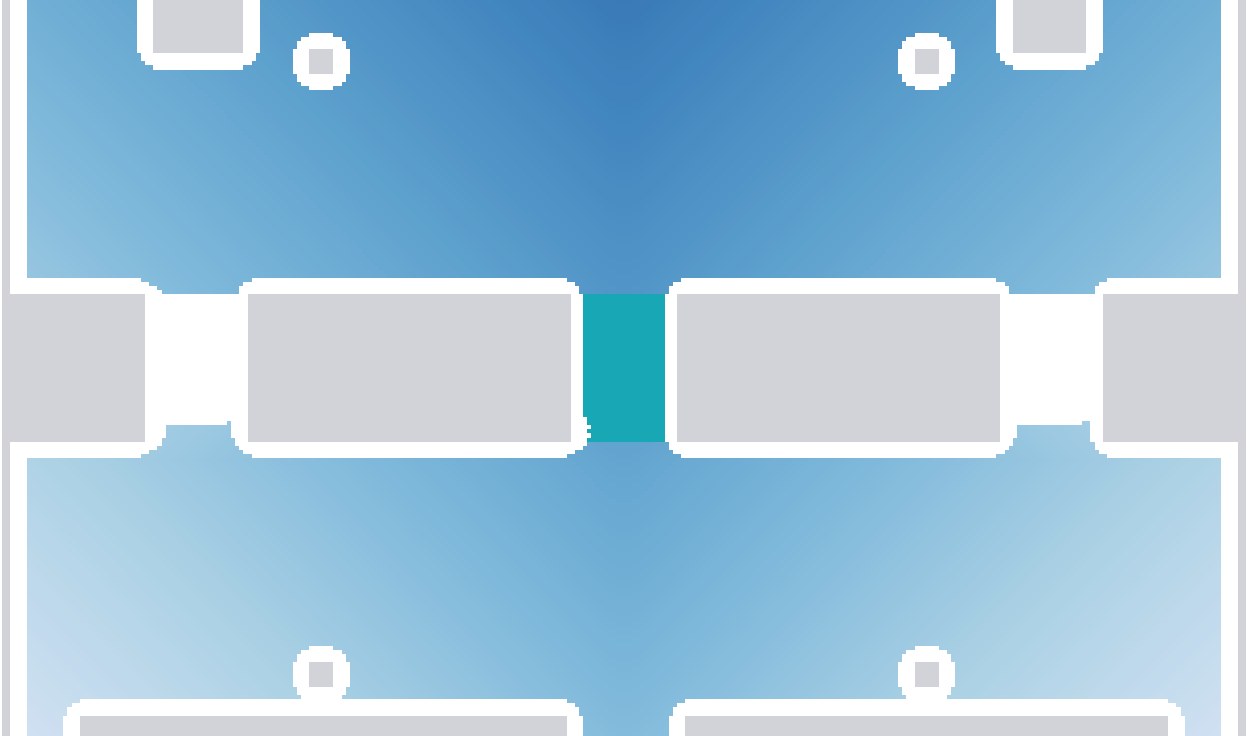 The route
A route made of knowledge
The fixed point stops at the racking after 327 iterations. One announcement later it runs 582 and reaches the carrier through a bay no map contains.
See the fixed point →
The route
A route made of knowledge
The fixed point stops at the racking after 327 iterations. One announcement later it runs 582 and reaches the carrier through a bay no map contains.
See the fixed point →
 The map
 drifts, and the corridor narrows
The carrier's own SLAM map slides west along the lane, draws t2's wall down the bay's centre, and cuts 277 of its 712 cells from the route.
Read the grids →
The map
The map drifts, and the corridor narrows
The carrier's own SLAM map slides west along the lane, draws t2's wall down the bay's centre, and cuts 277 of its 712 cells from the route.
Read the grids →