Epistemic SLAM
Two views of one fact, and the moment they come apart
The demonstrations on this site rest on a coincidence that is easy to
miss because it holds so consistently. A robot drives, its laser sweeps,
slam_toolbox writes what it saw into a
grid, and the epistemic layer writes the same event into a Kripke model.
A bay the robot has not entered is unobserved in the grid and undecided
in the model at once. Those are two views of one fact, and keeping them
that way is what makes a run honest: no prepared map is published
anywhere, so the robot cannot know a thing it did not look at.
The coincidence holds because one robot's observation drives both views.
What this run does is take it away.
Three things SLAM does not store
An occupancy grid records a probability per cell. It does not record
whose probability it is. A robot handed a merged map holds cells it
never saw, and nothing in the format distinguishes them from cells it
measured itself. That distinction is the whole of what the collaborative
layer adds: coverage is a mask of what this robot observed, not of what
is free in the map it happens to hold.
Nor does the grid record abstention. A cell at −1 was never
observed, and a cell whose probability sits between the thresholds was
observed and not resolved. Both are unknown to the epistemic layer, and
collapsing the second into free or occupied would hand the model a
certainty the sensor never produced. An occupancy grid stores a
probability and a modal formula needs a decision, so a threshold has to
be chosen somewhere; it is chosen once, in the classification, and
nowhere else.
And it does not record disagreement. Two robots that observed the
same cell and reached opposite conclusions have produced a fact about the
fleet, not a defect in either map. Reconciliation here records the
contradiction and does not stop; a disputed cell that somebody can go and
look at again is worth more than a hole punched in the map, and worth
much more than an average of the two readings, which would describe a
floor neither robot saw.
Where knowledge ends and belief begins, in metres
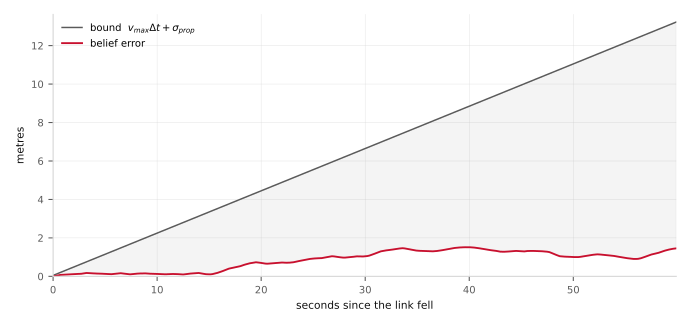
While the link is up, what one robot holds about its partner is a
received measurement: the partner said where it was, and the statement
inherits whatever the partner's own localisation was worth. The instant
the link falls that stops being an observation of anything. What
continues is inference from a motion model, and the covariance is the
distance it has travelled from the fact.
That gives the boundary a number, which is unusual. In the epistemic
models on this site an agent either knows which of two worlds it is in or
it does not, and the survey domains are built so that the question is
settled by looking. Here the same distinction is continuous: the disc on
the left of the film is how far the belief has drifted from being
knowledge, and it widens for as long as nothing arrives. At fifty seconds
it passes the threshold, and past that point the proposition about where
the partner is has no business being treated as something the robot
knows. The engine says so; what it cannot do is act on it, because
marking that proposition uncertain means editing a model, and there is
one model for the whole fleet rather than one per robot.
That last clause is the honest edge of this run. The two grids diverge
because two robots observed different things while incommunicado, and
reconciling them is the operation this layer performs. The two
models never diverge, because there is only one, and an
accessibility relation in it is a column of a shared structure and not a
perspective held on a robot. Partitioning the model is a different piece
of work.
Why merging maps is not a registration problem
The obvious reading of what happens at reconnection is that two grids
must be aligned and combined. That reading is available and it is the
wrong one. The alignment is arithmetic: both maps came from the same
simulator at the same resolution, and putting them on a common extent is
a translation by whole cells, with no interpolation and no rotation. Maps
at different resolutions are refused rather than approximated, because a
wrong registration produces a merged map that is confidently wrong, which
is worse than one that is obviously missing.
What is not arithmetic is the question underneath: after the merge, what
does each robot know? The answer is not the union of the grids. It is a
per-robot fact, and this run reports it as one: the believing robot
learned 5 246 cells it had never observed, the patrolling one
4 870, and neither now confuses them with cells it measured. That
accounting is what the layer exists for, and it is the part an occupancy
grid has no field for.