An epistemic policy was executed over an Open-RMF fleet across three
floors of a hotel, and the state of the agents' knowledge was measured
after every action. The run ends with two of the three agents holding
beliefs the world contradicts. Each of those beliefs is attributable to a
single action, and the accessibility relation of the agent concerned
stops being reflexive at exactly that step, which is the formal signature
of the frame leaving \(\mathrm{S5}_n\) for \(\mathrm{KD45}_n\).
Planned by Aletheia over
hotel-incident.epddl, executed by
eplansys on PlanSys2,
dispatched to Open-RMF by
eplansys-rmf.
All figures below are generated from the measured run.
The problem
A mission stated as a modal formula
A leak is in one of two suites, l2_suite
and l3_suite, on separate floors. Its
location is settled in the world and unknown to the fleet, so the initial
model has two worlds and designates both. Three agents participate: an
inspector and a
porter, each bound to a robot, and a
guest, which is an agent of the model
with no robot and no actions available to it.
whose three conjuncts constrain the plan in three different ways. The
first is ontic and requires the leak to be shut off, which carries a
modal precondition: an agent may close a valve only in a suite it knows
to be flooded, so the plan must contain an act of sensing. The second
requires the porter to come to know an ontic fact. The third requires the
guest to remain uncertain about the location, and it is this conjunct
that removes the public address system from the admissible plans.
The action library is the intermediate
set. Movement is public-ontic; inspection
is semi-private-sensing, so the fleet
observes that an inspection occurred and does not observe its outcome;
containment is private-ontic and is
observed only by agents in the suite; the radio is
quasi-private-announcement and the public
address system is public-announcement.
The policy
Solution structure
Aletheia solved the instance by AO* search at depth 4, expanding
15 164 nodes and generating 16 796. The result was validated
over two leaves and six branches. The executor rendered it as a tree of
six nodes.
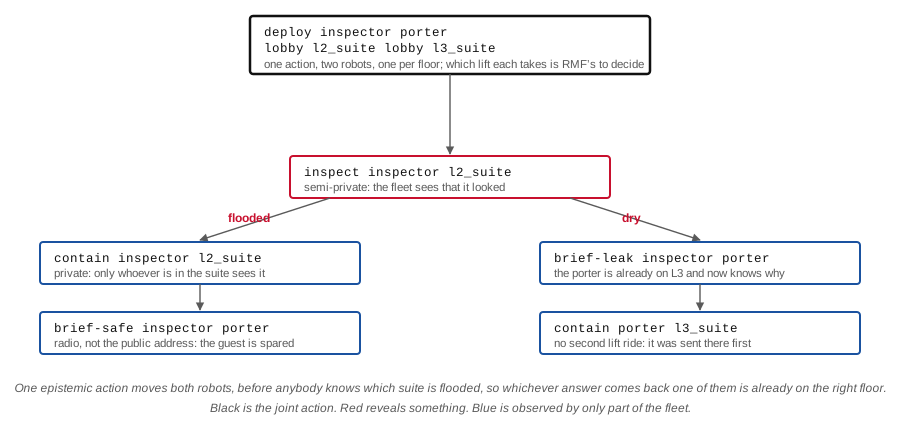
Figure 1. The policy. The root moves both agents in one action.
The inspection has two outcomes, and the continuation differs between
them.
Three properties of this policy follow from the goal alone. The root
commits both robots to different floors before the leak's location is
known, which places one of them on the correct floor under either outcome.
The private radio carries the finding, since a public announcement would
falsify the third conjunct. The dry branch closes the valve with the
porter, which is already on the floor the inspection implicates, so the
solution contains no second lift traversal.
Concurrency and the order of updates
A policy is a sequence of product updates and the executor renders it as
a Sequence node, so two consecutive move
actions produce two robots moving one after another. Simultaneous motion
requires a single event that relocates several agents, which the domain
provides as deploy:
The bridge submits one RMF task per agent named in such an action and
holds the PlanSys2 action open until every task reports completion,
failing the action as soon as any one of them fails.
Execution
The run on the fleet
Figure 2. The recorded run, with the leak in the L3 suite, so the
inspection returns dry and the policy takes its second branch. Gazebo on
the left, looking straight down at the building, showing whichever floor
the mission is acting on: the lobby while the two robots ride, L2 for the
inspection, L3 for the containment. The Open-RMF floorplan is on the
right. Recorded on a display of its own; sped up four times, with
captions generated from the run's log.
Wall-clock time for each action, from the moment the bridge submitted it
to the moment the epistemic state applied the corresponding update:
step
action
execution
|W|
|D| inspector
|D| porter
|D| guest
0
initial state
–
2
2
2
2
1
deploy
484.5 s
2
2
2
2
2
inspect
1.0 s
2
1
2
2
3
brief-leak
4.3 s
4
1
1
2
4
contain
13.0 s
5
1
1
2
The joint move accounts for 96 % of the 505.8 s execution time. It comprises
two lift traversals across three levels, performed concurrently, and
Open-RMF resolved a traffic conflict between the two robots on the way out
of the lobby and assigned each of them a lift. The epistemic work that
follows occupies 18.3 s in total.
Measurement
The model after every update
The run was replayed against a standalone epistemic state, and after each
action three quantities were recorded for every agent: the number of
worlds in its perspective, the number of worlds it designates, and whether
that perspective contains the world that is the case. The accessibility
relation was recorded with them, which permits the frame property to be
checked directly.
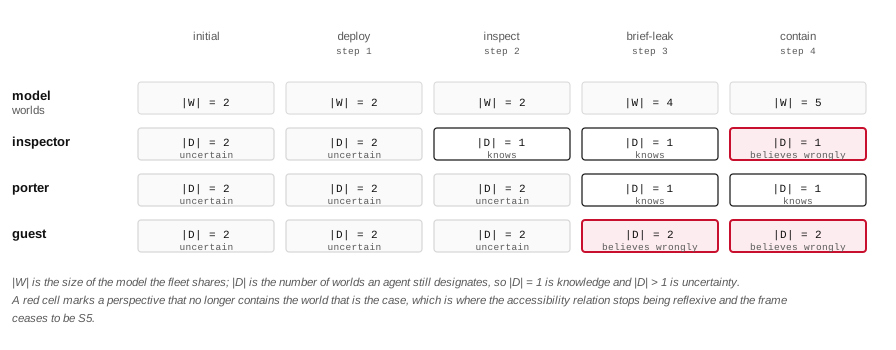
Figure 3. The measured run. |D| = 1 is knowledge of the
proposition at issue; |D| > 1 is uncertainty. Red marks a perspective
that excludes the actual world.
Two features of this table carry the argument. The size of the shared
model increases from two worlds to five, and it does so at the two steps
where only part of the fleet observes what happened. A private
announcement introduces the distinction between a world in which the
message was sent and a world its non-recipients continue to inhabit; a
private ontic action introduces the distinction between a world in which
the valve is closed and a world in which the agents that did not see it
still believe it open.
The second feature is the red cells. At step 3 the guest's perspective
ceases to contain the actual world, and at step 4 the inspector's does the
same. Both agents continue to designate worlds and to satisfy every
formula those worlds support, and both are wrong.
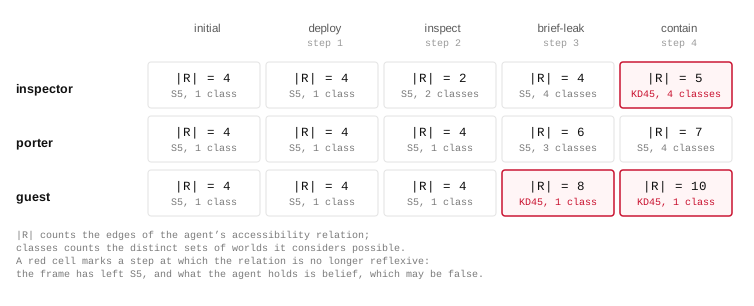
Figure 4. The same relations counted as graphs. The preceding
table counts vertices; this counts edges and checks the closure
properties they satisfy, which is what fixes the logic the run is in. A
relation that is reflexive, transitive and Euclidean gives
\(\mathrm{S5}\) and reads as knowledge. The guest's relation loses
reflexivity at the private announcement and the inspector's at the
private ontic action, and each remains serial, transitive and Euclidean
without it, which is \(\mathrm{KD45}\): what those agents hold from
that step on is belief, and it is false. The porter's relation stays
\(\mathrm{S5}\) throughout while its edge count rises from four to
seven, since the model it is defined over grows from two worlds to five.
The accessibility relations
Figure 5. Each agent's accessibility relation, stepped through the
run. Nodes are worlds and arcs are the relation; a red ring marks a world
the agent designates, and a world drawn faintly is one the model does not
yet contain. An agent whose panel reports that it excludes the actual world
has lost the self-loop there.
In the initial model all three relations are the complete graph on two
worlds, and every agent designates both. After the inspection the
inspector's relation has lost the arc between them and designates one,
while the relations of the porter and the guest are unchanged: the fleet
observed that an inspection took place and did not observe what it found.
After step 3 the guest's relation has no self-loop at the actual world,
and after step 4 the inspector's has none either. Reflexivity is the
property that makes knowledge factive, so its loss is what allows an agent
to be mistaken. This is measured directly:
step
inspector
porter
guest
initial
reflexive
reflexive
reflexive
1 · deploy
reflexive
reflexive
reflexive
2 · inspect
reflexive
reflexive
reflexive
3 · brief-leak
reflexive
reflexive
irreflexive
4 · contain
irreflexive
reflexive
irreflexive
The frame of the reachable state space is therefore \(\mathrm{S5}_n\)
through step 2 and \(\mathrm{KD45}_n\) thereafter. The transition occurs
during execution, and it is caused by actions the plan selected.
Verification
The goal, evaluated in the final model
A goal is a formula of the modal language and a model either satisfies it
or does not, but the bare verdict discards the quantity that decides it.
The semantics assigns a formula its extension
\([\![\varphi]\!]^{\mathcal{M}} = \{w \in W : \mathcal{M}, w
\models \varphi\}, \qquad
[\![K_i\varphi]\!] = \{w : R_i(w) \subseteq [\![\varphi]\!]\},\)
and the goal is satisfied exactly when \(W^{*} \subseteq
[\![\gamma]\!]\). Extension and containment are what is reported below.
They are computed by the labelling algorithm, which evaluates every
subformula bottom-up over the subformula order in \(O(|\mathrm{Sub}
(\gamma)| \cdot (|W| + |R|))\), on the models recorded during the run.
Every verdict the executor reported is reproduced, which is what licenses
reading the rest of the figure.
The extension of each subformula of the goal, after every action\(\gamma \equiv \texttt{safe} \wedge K_{\texttt{porter}}\,\texttt{safe} \wedge \neg \mathit{Kw}_{\texttt{guest}}\,\texttt{leak-at}\_\texttt{l2}\_\texttt{suite}\)
A dot is a world of that step’s model, filled where the formula holds and ringed where the world is designated. The goal is satisfied exactly where every ringed dot in the bottom row is filled, which is the containment \(W^{*} \subseteq [\![\gamma]\!]\).
Two rows say more than a truth value could. The secrecy conjunct
\(\neg\mathit{Kw}_{\texttt{guest}}\,\texttt{leak-at}
\_\texttt{l2}\_\texttt{suite}\) holds at every world of every model in
the run: the guest is uncertain not merely where the world happens to be
but everywhere the model reaches, so the conjunct is satisfied with the
whole model as margin and no continuation of the run could falsify it by
moving the point. The ontic conjunct is the opposite case. In the final
model \([\![\texttt{safe}]\!] = \{w_0\}\) out of five worlds, so the
goal is met at one world and fails at the other four, and the margin is a
single world.
The last row is outside the goal and describes the agent that organised
the outcome. \([\![K_{\texttt{inspector}}\,\texttt{safe}]\!]\) is
empty in the final model: the inspector does not know that the incident is
over, because the porter closed the valve on another floor and nobody told
it. The mission is satisfied while the agent that began it holds a false
belief about its result.
The same question as a refutation
The labelling algorithm is one decision procedure and the reduction to
propositional satisfiability is another. Introduce a variable
\(x_{\psi,w}\) for each \(\psi \in \mathrm{Sub}(\gamma)\) and each
\(w \in W\), assert the defining clauses of each connective and each
modality, and assert \(\neg x_{\gamma,w}\) at a designated world. The
resulting formula is unsatisfiable exactly when
\(\mathcal{M}, W^{*} \models \gamma\), so the goal test is a
refutation and the refutation is a certificate.
The goal test on the final model, as a propositional refutation45 variables, 108 clauses
\(\neg x_{\gamma,w} \ \text{ for each } w \in W^{*}\)
1
unsatisfiable · 45 unit propagations, 0 decisions · \(\gamma\) is entailed at every designated world, so the goal holds.
The same question decided as a propositional refutation. Every recorded verdict of the run is reproduced by both procedures.
The count that matters is the last one. The valuation fixes every atomic
variable as a unit clause, and the defining clauses propagate those
assignments up the subformula order without ever leaving a clause with two
unassigned literals, so DPLL closes the instance with no decision at all.
Model checking a fixed finite model is not the search problem planning is:
the search happens once, when the policy is built, and never again when a
state is asked whether it satisfies the goal. Both procedures agree with
each other and with the executor at every step of the run.
Architecture
The division of decisions
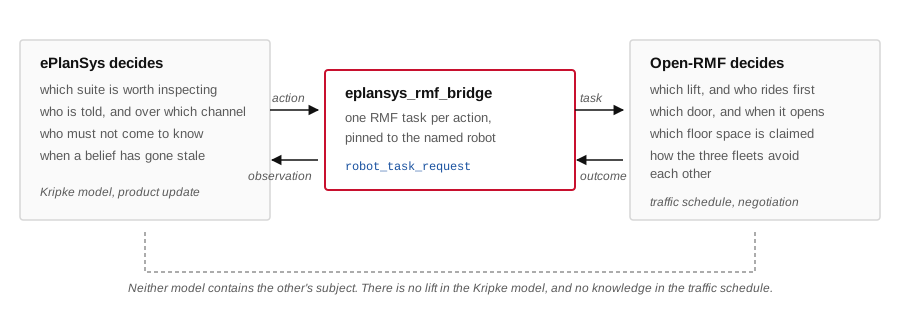
Figure 6. The interface. The bridge is a PlanSys2 performer that
submits one RMF task per action and reports what the robot observed.
A go from the lobby to the L3 suite is
one action in the epistemic model. Its execution comprises a lift call, a
door, a floor transition and a negotiation with whichever cleaning robot
requested the same lift. The Kripke model contains no lift and the traffic
schedule contains no knowledge, and each system decides only what it can
represent.
Allocation
Both systems allocate. The planner assigns actions to named agents during
search and the epistemic model records knowledge against those names;
Open-RMF's dispatcher receives bids and selects a robot. Divergence
between the two produces a model in which an agent is credited with
sensing something it never observed, and no error is raised anywhere. The
bridge therefore binds each agent to one robot and submits a
robot_task_request, which the named
robot's task manager accepts without a bid. RMF's traffic management is
retained in full and its allocation is given up. An agent bound to no
robot causes the action to be refused, which is the treatment the
guest receives.
The return path
A sensing action's outcome determines which branch of the policy executes,
so the bridge requires a token from the fleet. Open-RMF reports task
completion as a status drawn from a fixed enumeration.
task_state.json declares no result
property at any level, and
ActionExecution::finished() takes no
argument. Two free-form fields travel with a task and the bridge reads
both: an event's detail string, and the
log entries a performer writes. A value carrying the prefix
eplansys.outcome= in either is taken as
the outcome. On Humble this stream leaves the fleet adapter over the
websocket named by its server_uri
parameter alone, so the bridge serves that socket.
In the recorded run the token is supplied by the task map, and the bridge
records that substitution in the log at every occurrence. A fleet adapter
reporting a measurement would override it, and every step upstream of that
line is identical in the two cases.
The argument selects which suite is flooded, and the two values drive the
policy down its two branches. The world, its three fleets and its two
lifts are the unmodified rmf_demos hotel.
The recorder drives the demo on a private X display and composes the two
windows into the film. The analysis replays the action sequence taken from
the run's own log against a standalone epistemic state, so Figures 3 and 4
describe the execution that occurred. The domain and its instances are in
epddl-workspace/hotel-incident/, and the
demo package installs them from there without copying.